
Contents
 Moving from individual AI tools to integrated AI systems requires strategic planning and organizational change
The AI Tools Trap: Why Most Companies Are Stuck
Walk into any Jordanian company today-from Amman's tech startups to established enterprises in Irbid and Aqaba-and you'll find the same pattern. Marketing teams are using Canva AI to generate social media graphics. Developers are consulting ChatGPT for code suggestions. Customer service representatives are experimenting with ai chatbot interfaces. Content creators are playing with ai image generator and ai video generator tools.
This is progress, but it's also a trap.

According to recent market research, 87% of businesses in the MENA region are using at least one AI tool, but only 12% have deployed AI as an integrated system. The difference between these two approaches determines whether AI becomes a genuine competitive advantage or just another expensive experiment.
Why Individual Tools Fail at Scale
The Data Disconnect When your sales team uses ChatGPT to draft emails, that AI has no access to your CRM data, customer history, or brand guidelines. Every query starts from zero. There's no learning, no consistency, no integration with your actual business processes.
The Security Black Hole Each time an employee pastes proprietary information into a public AI tool, you create potential data leakage. There's no audit trail, no approval workflow, no compliance framework. For industries like banking, healthcare, or legal services in Jordan, this isn't just inefficient-it's legally risky.
The Knowledge Waste Your company has accumulated years of industry knowledge, customer insights, and operational expertise. None of this reaches the AI tools your team uses. You're paying for generic AI when you need specialized intelligence.
The ROI Invisibility When AI usage is scattered across dozens of individual tools and hundreds of employees, measuring actual business impact becomes impossible. You can't optimize what you can't measure.
Understanding the Gap: Tools vs Systems
Let's be precise about what separates AI tools from AI systems:
AI Tools: The Current Reality
| Characteristic | Description | Business Impact |
|---|---|---|
| Access Method | Public web interfaces (ChatGPT, Gemini, Canva AI) | No integration with company data |
| Data Usage | Generic training, no company context | Generic outputs, frequent hallucinations |
| Security | Consumer-grade, terms of service apply | Data exposure risks, compliance issues |
| Governance | None-individual employee discretion | No auditability, inconsistent quality |
| Cost Structure | Per-seat subscriptions | Unpredictable, hard to control |
| Scaling | Manual, user-dependent | Doesn't scale with business growth |
AI Systems: The Strategic Approach
| Characteristic | Description | Business Impact |
|---|---|---|
| Access Method | Internal interfaces, API integrations | Seamless workflow integration |
| Data Usage | Company knowledge base, RAG systems | Accurate, context-aware responses |
| Security | Enterprise-grade, on-premise options | Full data control, audit trails |
| Governance | Defined policies, approval workflows | Quality assurance, compliance ready |
| Cost Structure | Infrastructure + implementation | Predictable, ROI-measurable |
| Scaling | Automated, process-integrated | Grows with business needs |
The transition from the left column to the right column is not a technical problem-it's an organizational transformation.
The Four Pillars of AI System Deployment
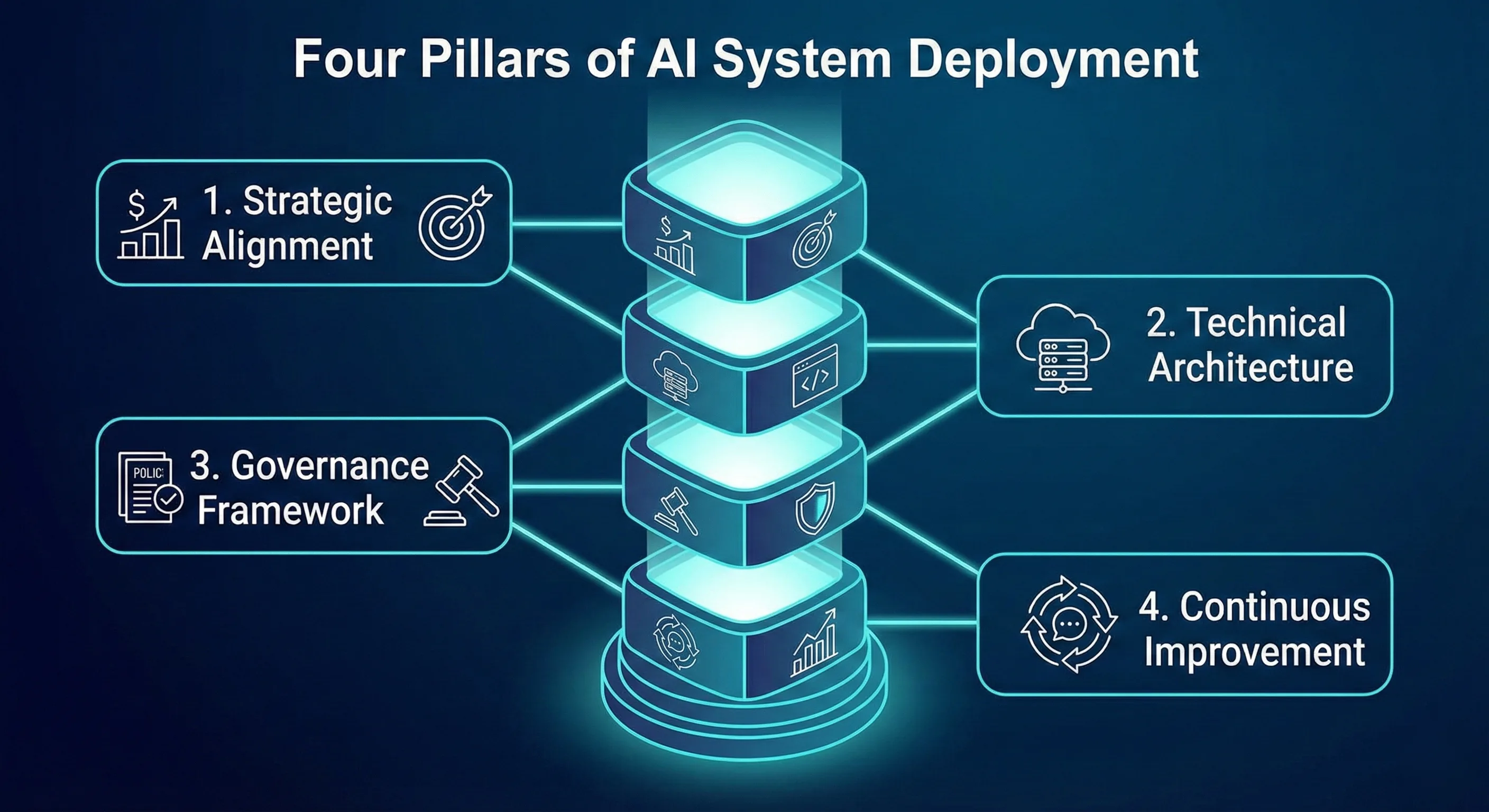 Successful AI deployment rests on four interdependent pillars
Pillar 1: Strategic Alignment
Before deploying any AI system, you need clarity on:
Business Objectives
Successful AI deployment starts with answering three fundamental questions: What specific problems will AI solve? What metrics define success? Which processes will benefit most from automation or augmentation? Without clear answers to these questions, AI initiatives drift into experimentation without delivering measurable business value.
Use Case Prioritization Not all AI applications deliver equal value. A systematic approach:
# AI Use Case Prioritization Framework
use_case_score = (
    business_impact * 0.4 +
    technical_feasibility * 0.3 +
    data_availability * 0.2 +
    time_to_value * 0.1
)
For Jordanian companies, high-impact use cases often include Arabic language customer service (learn more about AI chatbot deployment), multilingual content generation (see AI content generation best practices), process automation in repetitive tasks, and data analysis for market insights.
Change Management
AI systems fail when people resist them. Your deployment strategy must include executive sponsorship with clear communication from the top, comprehensive training programs for affected teams, incentive structures aligned with new workflows, and a gradual rollout approach with continuous feedback loops to address concerns before they become blockers.
Pillar 2: Technical Architecture
This is where most companies need external expertise. The architecture decisions you make now determine your AI capabilities for years to come.
Infrastructure Choices
| Option | Best For | Considerations |
|---|---|---|
| Cloud-Based (AWS, Azure, GCP) | Most enterprises | Scalability, managed services, ongoing costs |
| On-Premise | Regulated industries | Full control, higher initial investment |
| Hybrid | Large organizations | Flexibility, complexity management |
Integration Patterns
Your AI system must connect with existing business infrastructure including CRM systems, ERP platforms, communication tools (email, Slack, Teams), data warehouses and business intelligence tools, and industry-specific software. These integrations determine whether AI becomes a seamless part of daily operations or an isolated experiment that employees ignore.
RAG System Design For most business applications, Retrieval-Augmented Generation (RAG) provides better results than fine-tuning:
# Simplified RAG Architecture
class EnterpriseRAGSystem:
    def __init__(self):
        self.vector_db = initialize_vector_database()
        self.llm = initialize_language_model()
        self.knowledge_base = load_company_documents()

    def query(self, user_question):
        # Retrieve relevant context
        relevant_docs = self.vector_db.similarity_search(
            user_question,
            k=5
        )

        # Augment prompt with context
        enhanced_prompt = f"""
        Context: {relevant_docs}

        Question: {user_question}

        Answer based only on the provided context.
        """

        # Generate response
        response = self.llm.generate(enhanced_prompt)
        return response
This architecture ensures AI responses are grounded in your actual company data, dramatically reducing hallucinations. Read more about implementing AI chatbots with proper data integration.
Pillar 3: Governance Framework
This is the most underestimated aspect of AI deployment-and potentially the most important for Middle Eastern companies navigating diverse regulatory environments.
Policy Components
Data Governance
Establish clear policies governing what data AI systems can access, how sensitive information is filtered, retention and deletion policies, and compliance with Jordan's Data Protection Law. These policies protect both your organization and your customers while enabling AI to access the data it needs to deliver value.
Complete guide to AI governance for Jordanian companies
Usage Policies
Define who can access which AI capabilities, what approval workflows apply to different use cases, how to prevent misuse or bias, and escalation procedures for errors. These policies ensure AI systems empower employees without creating compliance or reputational risks.
Audit and Compliance
Implement comprehensive logging of all AI interactions, regular bias and fairness assessments, compliance documentation for regulators, and incident response procedures. These practices create the audit trail necessary for regulatory compliance while identifying quality issues before they impact customers.
Quality Assurance
Maintain human-in-the-loop oversight for critical decisions, automated testing of AI outputs, feedback mechanisms for continuous improvement, and performance monitoring dashboards. Quality assurance transforms AI from an unpredictable tool into a reliable business system.
Pillar 4: Continuous Improvement
AI systems are never "finished." The final pillar ensures your AI investment continues delivering value:
Performance Monitoring
| Metric Category | Key Indicators | Review Frequency |
|---|---|---|
| Technical Performance | Latency, uptime, error rates | Real-time |
| Business Impact | Cost savings, revenue impact, efficiency gains | Monthly |
| User Adoption | Active users, query volume, satisfaction scores | Weekly |
| Data Quality | Accuracy, relevance, hallucination rates | Daily |
Feedback Loops
Establish mechanisms for user feedback collection and analysis, A/B testing of different AI approaches, regular model updates and retraining, and knowledge base expansion. These feedback loops ensure your AI system improves continuously rather than degrading over time as business conditions change.
ROI Measurement Learn how to measure real business impact of AI projects
Jordan's AI Readiness: Challenges and Opportunities
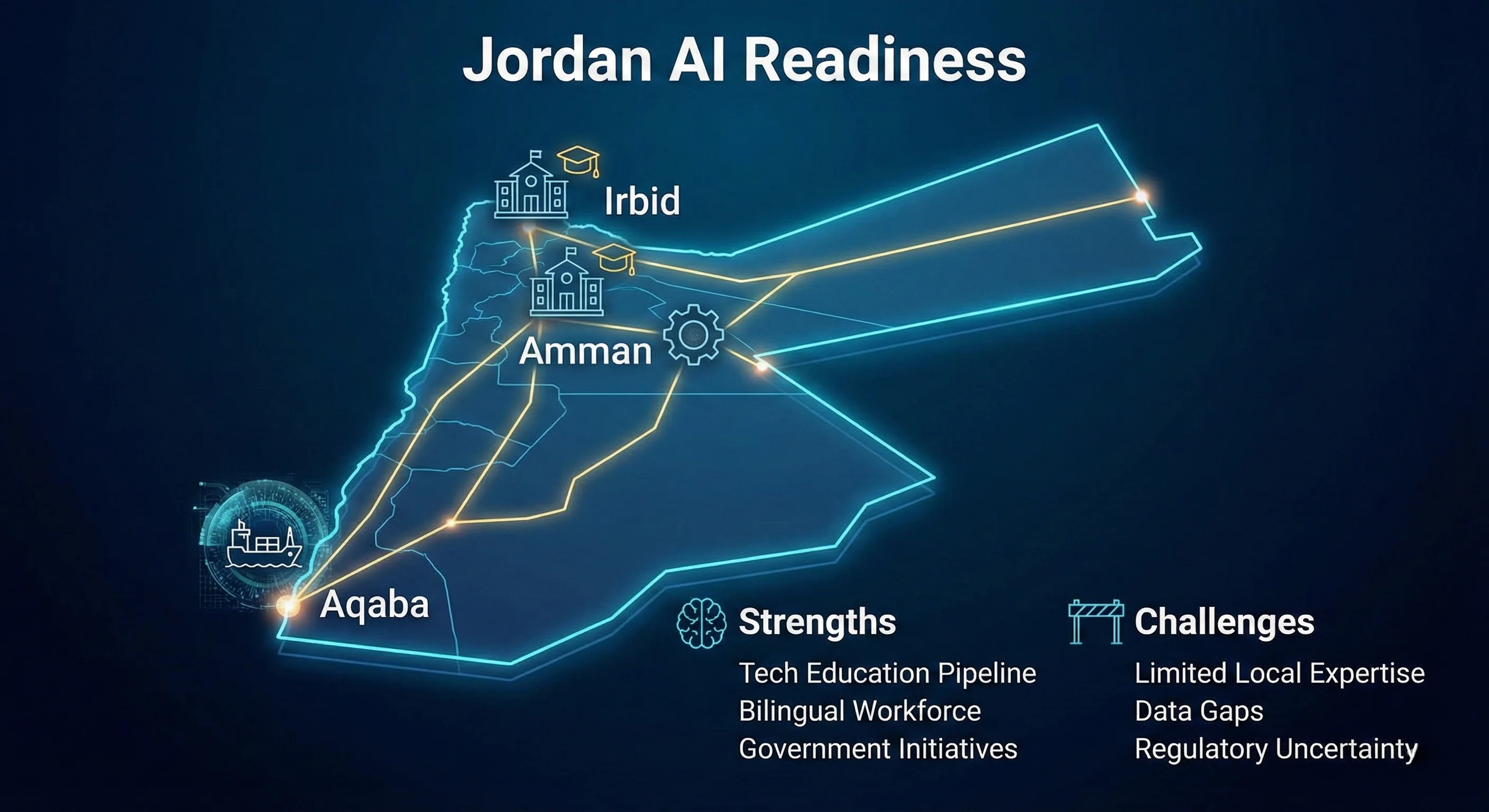 Jordan's tech sector is positioned for AI transformation with the right strategic approach
Current Landscape
Jordan's technology sector has unique advantages for AI adoption:
Strengths
- Strong tech education pipeline (universities in Amman, Zarqa, Irbid)
- Established IT services sector
- Growing startup ecosystem
- Government digital transformation initiatives
- Bilingual workforce (Arabic-English)
Challenges
- Limited local AI expertise at scale
- Data infrastructure gaps
- Risk-averse corporate culture
- Budget constraints in mid-sized companies
- Regulatory uncertainty around AI
Sector-Specific Opportunities
Financial Services
Jordan's banking sector can leverage AI for credit risk assessment with local market data, fraud detection for digital transactions, Arabic-speaking customer service automation, and compliance monitoring for Central Bank regulations. These applications address both operational efficiency and regulatory requirements specific to Jordan's financial sector.
Healthcare
Medical facilities can deploy AI for patient data analysis enabling better diagnostics, administrative automation in hospitals, telemedicine enhancement, and Arabic medical record processing. These systems improve patient outcomes while reducing the administrative burden on healthcare professionals.
Retail and E-commerce
Retailers can implement AI for personalized product recommendations, dynamic pricing optimization, inventory management, and Arabic customer support (AI chatbot implementation guide). These capabilities help Jordanian retailers compete with international e-commerce platforms.
Tourism and Hospitality
The tourism sector benefits from multilingual customer service, booking optimization, personalized travel recommendations, and content generation for marketing (AI content tools guide). Given Jordan's position as a tourism destination, these AI applications directly impact revenue and guest satisfaction.
Building Your AI Deployment Roadmap
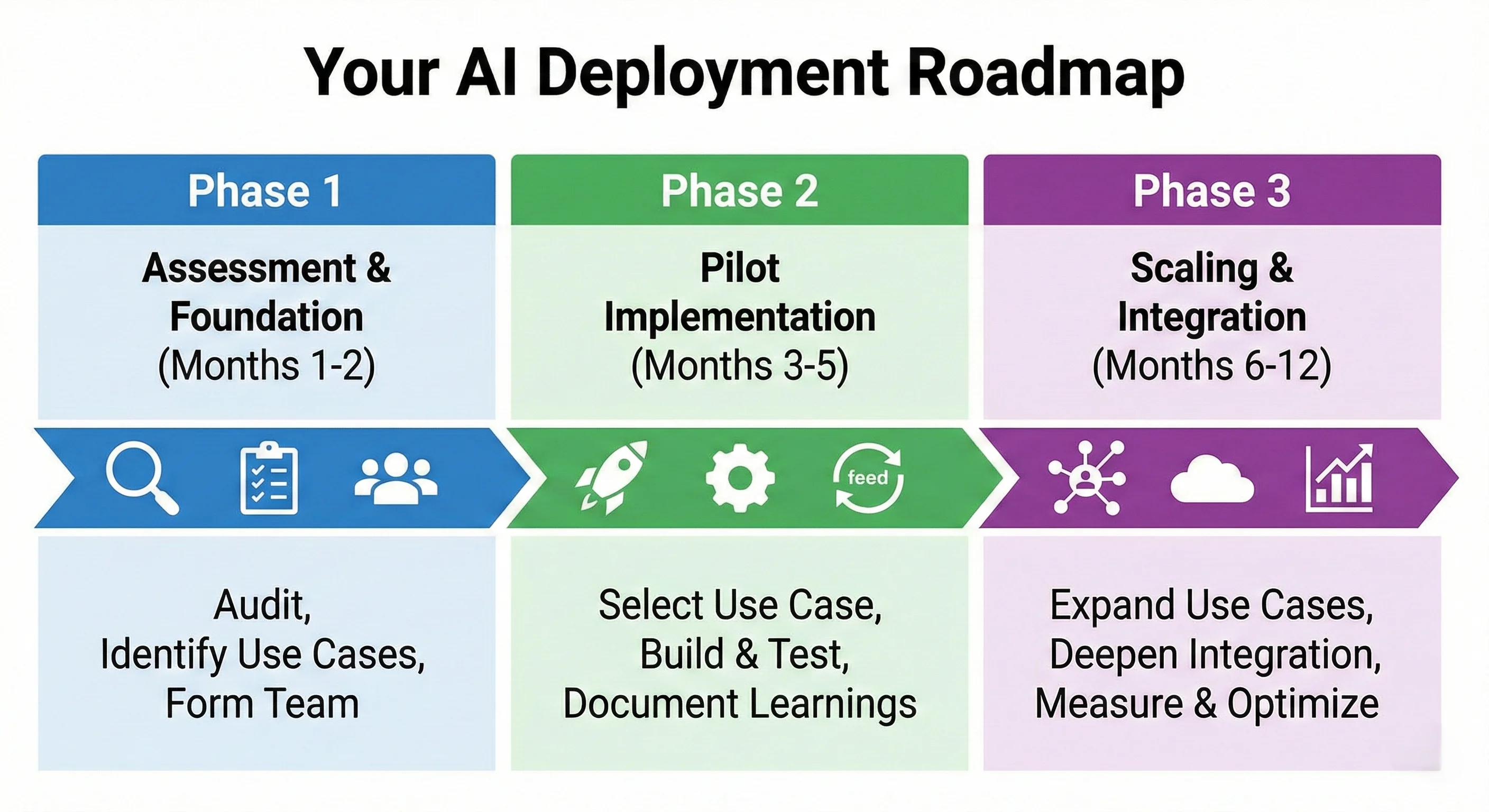 A phased approach reduces risk while building organizational capability
Phase 1: Assessment and Foundation (Months 1-2)
Current State Analysis
- Audit existing AI tool usage across departments
- Identify high-value use cases
- Assess data readiness and quality
- Evaluate technical infrastructure
- Map regulatory requirements
Quick Wins Identification
Start with projects that deliver fast ROI such as automating repetitive customer inquiries, generating standard business documents, analyzing customer feedback, and scheduling and calendar management. These quick wins build organizational confidence while demonstrating tangible value.
Team Formation
Establish an AI steering committee:
- Executive sponsor
- IT/technical lead
- Business unit representatives
- Legal/compliance officer
- Change management lead
Phase 2: Pilot Implementation (Months 3-5)
Select One High-Impact Use Case
Choose something that:
- Solves a real pain point
- Has measurable success metrics
- Affects a manageable user group
- Can be completed in 8-12 weeks
Build and Test
- Develop the AI system with proper architecture
- Integrate with existing tools and data
- Implement governance framework
- Train initial user group
- Monitor and refine based on feedback
Document Learnings
Capture comprehensive insights including what worked well, what unexpected challenges arose, how users responded, and what you would do differently in future deployments. This documentation becomes invaluable for scaling AI across your organization and avoiding repeated mistakes.
Phase 3: Scaling and Integration (Months 6-12)
Expand to Additional Use Cases
Apply learnings from pilot deployments to adjacent departments or processes, more complex applications, additional data sources, and broader user groups. Each expansion builds on proven patterns while extending AI capabilities into new areas of the business.
Deepen Integration
Connect AI systems with more business processes, automate workflows end-to-end, build custom interfaces for specific roles, and establish centers of excellence. Deeper integration transforms AI from a helpful addition into a core business capability.
Measure and Optimize
Track ROI metrics rigorously, gather continuous user feedback, refine models and prompts, update governance policies, and plan next-generation capabilities. Continuous measurement ensures your AI investment delivers sustained value rather than producing initial excitement that fades over time.
Real-World Success Stories
Case Study: Jordanian Retail Bank
Challenge: Customer service team overwhelmed with repetitive inquiries in Arabic and English, leading to long wait times and high operational costs.
Solution: Deployed an internal AI chatbot system integrated with customer database and banking knowledge base.
Results:
- 60% reduction in routine inquiry handling time
- 24/7 availability for customers
- 40% decrease in customer service costs
- 85% customer satisfaction with AI interactions
- Complete audit trail for regulatory compliance
Key Success Factor: Unlike public AI tools, the system accessed real customer data securely while maintaining strict privacy controls.
Case Study: Amman-Based Marketing Agency
Challenge: Content production bottleneck-couldn't scale personalized marketing across multiple clients without hiring significantly.
Solution: Implemented an AI-powered content pipeline with brand guidelines, approval workflows, and quality controls.
Results:
- 5x increase in content output
- Maintained brand consistency across all clients
- 50% reduction in content production costs
- Faster campaign launches
- Retained full creative control and legal compliance
Key Success Factor: Moving beyond tools like Canva AI to a governed system with proper brand safeguards and workflow integration.
Working with AI Implementation Partners

Most Jordanian companies lack the internal expertise to design and deploy AI systems at scale. This isn't a weakness-it's simply reality. Even global enterprises partner with specialists for AI transformation.
What to Look For in an AI Partner
Technical Competence
Look for partners with experience in enterprise AI architecture, knowledge of your industry's specific challenges, proven deployment methodology, and familiarity with Middle Eastern market context. Technical competence without industry understanding often produces elegant systems that don't solve real business problems.
Strategic Thinking
Partners should focus on business outcomes rather than just technology, help prioritize use cases for maximum ROI, understand organizational change management, and plan for long-term capability building. Strategic thinking ensures AI deployments deliver business value, not just technical achievements.
Local Presence and Understanding
Choose partners who understand Jordanian regulatory environment, have experience with Arabic language AI applications, possess knowledge of local business culture, and remain accessible for ongoing support. Local understanding prevents costly missteps and accelerates deployment timelines.
Conclusion: From Experimentation to Execution
The companies that win with AI in the next five years won't be those with the most ChatGPT subscriptions or the flashiest ai image generator demos. They'll be the organizations that systematically deploy AI as integrated systems-with clear strategy, robust architecture, strong governance, and continuous improvement.
Key Takeaways:
✅ Individual AI tools create value, but AI systems create competitive advantage
✅ Technical deployment is only 30% of the challenge-organizational transformation is 70%
✅ Start with high-impact use cases, but plan for systematic scale
✅ Governance is not optional-it's the foundation of responsible, effective AI
✅ Partner with specialists to accelerate deployment while building internal capability
✅ Focus on measurable business outcomes from day one
The gap between AI experimentation and AI deployment is real, but it's not permanent. With the right approach, Jordanian companies can move from AI tourists to AI leaders-building systems that genuinely transform how they serve customers, operate internally, and compete in their markets.
Ready to move beyond AI tools? The transformation starts with understanding what's possible-and what's required to make it real. Contact Kawkab AI to discuss your AI transformation journey.
Frequently Asked Questions (FAQ)
Q: We're already using ChatGPT and Gemini across our team. Why do we need to build AI systems? A: Public AI tools are great for individual productivity, but they can't access your company data, integrate with your processes, or meet enterprise security standards. AI systems are designed specifically for your business context, delivering more accurate results while maintaining full control over data and compliance.
Q: How much does it cost to deploy AI as a system vs. using tools? A: Tool subscriptions might be $20-30 per user monthly, but they deliver limited business impact. System deployment requires upfront investment ($50,000-$500,000 depending on scope) but delivers measurable ROI through process automation, efficiency gains, and competitive advantage. Most companies see ROI within 6-12 months.
Q: Do we need to hire AI specialists, or can we work with partners? A: Most companies benefit from partnering initially while building internal capability gradually. This accelerates deployment, reduces risk, and allows your team to learn from specialists. Over time, you develop the internal expertise to manage and expand your AI systems.
Q: How long does it take to deploy an AI system? A: A focused pilot can be deployed in 8-12 weeks. Full enterprise deployment typically takes 6-12 months, with value delivery starting from the pilot phase. The key is starting with a clear use case and scaling systematically.
Q: What about data privacy and compliance in Jordan? A: This is precisely why systems matter more than tools. With proper architecture and governance, you maintain full control over data, implement audit trails, and ensure compliance with Jordan's regulations. Public AI tools offer no such guarantees. Learn more about AI governance.
Q: Can AI systems handle Arabic language effectively? A: Yes, modern AI systems excel at Arabic language processing, especially when properly configured with domain-specific knowledge. Enterprise deployments can be optimized for Arabic, English, or multilingual usage. See Arabic AI chatbot best practices.
Last updated: February 1, 2026 | Published by Kawkab.ai
About the Author

Ready to Transform Your Business?
Let's discuss how our AI solutions can help you achieve your goals.
Get Started Today